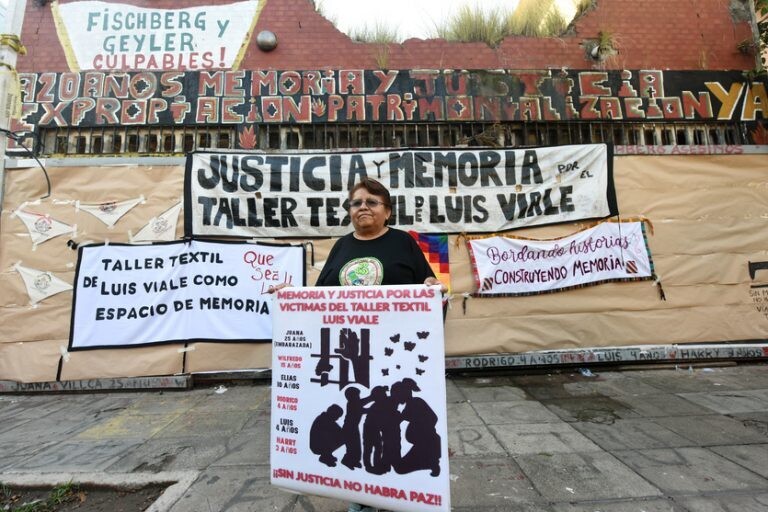
Twenty years ago, on March 30, 2006, six migrants died in a fire at a clandestine textile workshop on Luis Viale Street in the Caballito neighborhood. They were four children, a teenager, and a pregnant woman. Their names: Harry Rodríguez, 3 years old; Elías Carbajal, 10; Wilfredo Quispe Mendoza, 15; Juana Vilca, 25, pregnant; Luis Quispe, 4; and Rodrigo Carbajal, 4. This was not the first fire at that location, but the employers' negligence, combined with the conditions of precariousness and exploitation, enabled the tragedy to repeat itself. In June 2016, after a decade, the Oral Criminal Court No. 5 sentenced the workshop managers, Luis Sillerico and Juan Manuel Correa, to thirteen years in prison for reducing to servitude, and ordered the justice system to reinvestigate the owners of the brands for which the workshop produced exclusively. However, in May 2019, the owners of the brands and the property, Daniel Alberto Fischberg and Jaime Geiler, were acquitted by Judge Alberto Baños, then in charge of Criminal and Correctional Court No. 27. This is the same Alberto Baños who, years later, in December 2023, took office as an official in the government of Javier Milei to carry out the attack, emptying, and destruction of human rights policies and Memory Sites under the orbit of another denier, his friend Mariano Cúneo Libarona. To make matters worse, in 2022, the justice system returned the building to the owners who had been acquitted, and since then the place has been for sale, with no official recognition of what happened there. Survivors and social organizations have maintained the demand for the property to be expropriated and turned into a space of memory. "United we must continue fighting, enough discrimination, enough work-related deaths," claimed Lourdes, and added: "They put borders on us, but for labor exploitation, there are no borders." "20 years of impunity, 20 years of struggle, 20 years of resistance for the victims of the textile workshop on Luis Viale Street," said Lourdes Hidalgo, a survivor of the massacre. "Today we continue to stand firm with the demand for justice and memory for the textile workers and their children who lost their lives sewing soup. As is also seen today, it is very clear, notorious, the persecution against us for being migrant workers," she added. Both are now out of government, Baños since December 2025 and the former minister since March 4 of this year. As a judge, Baños dismissed the businessmen on the grounds that "it could not be proven that they knew the situation of servitude in the place." They were merely the owners of the place and benefited economically from its exploitation. In this process, the Luis Viale Commission was formed, which considers the massacre not an isolated fact, but the consequence of a system that allows and favors labor exploitation. That is why they believe that turning the place into a memory site will not only mean a recognition of the victims but also a warning about the persistence of these conditions today.